

This essay emerged from a conversation with my former boss and executive coach Cat Lee.
When I started working at Grubhub, it was my first experience working at a startup. The vibe shift was immediate. I came from a more mature environment that pushed specialization to grow my career. When I asked Matt, my boss, and the co-founder and CEO, what I should focus on upon joining Grubhub, he said I don’t care what you do. You can spend money, you can change the product. But you have to double the number of people that order food from us in the next couple of months.
That was the first lesson: I’m not going to tell you what to do. I’m going to tell you the outcome you’re going to deliver. You have to figure the rest out yourself.
And the vibe shift didn’t stop with Matt. I started right as we moved into a new office, and I hadn’t gotten my computer yet. When I arrived for the first day at the new office, there was a new desktop computer sitting on a desk I assumed was for me. I set it up and got up and running. When Mike, co-founder and CTO came in a little later, he asked if I set up the computer myself. When I said yes, he said, “Cool, you’re now going to do tech support for us.” And he wasn’t shitting me. For the next year and a half until we hired an IT person, I fixed viruses and other technical issues on people’s computers in addition to my job driving demand.
That was my second lesson: The reward for initiative is more work.
The lessons kept coming. The very next day, Mike came to me at my desk. He wanted to let me know we fired one of the sales people because he missed quota two months in a row. The CTO was telling me about sales firing decisions.
The third lesson: we’re transparent about what happens here regardless of role, and if you don’t produce you don’t stick around.
A few weeks later, I’m in a meeting with the two founders talking about growth. Mike turns to Matt and says, “We should just fire our marketing director and grow organically.” I was that marketing director. Matt engaged in the question instead of defending me. I asked if they wanted me to leave the room to discuss. (Fortunately, they decided not to fire me. I stayed for five and half years.) That was probably the next lesson, but I was too scared I was going to need to find another job to learn it at the time.
Another lesson: Fuck your feelings. We’re here to win.
A year later we hired someone with an amazing resume to help on the engineering side. We were very excited to bring her on, but in the first week she was waiting for people to tell her what to work on. She didn’t make it to the second week, and everyone at the company not only knew why, but agreed with the move.
By then we had all internalized what Mike and Matt had demonstrated to us time and again. If you expect us to mentor you and grow you, you’ve come to the wrong place. If you don’t grow yourself to have an immediate and sustained impact, you won’t stick around. And what’s weird about it is they’re right. That’s what makes it uncomfortable.
Over time, I realized this wasn’t accidental, but a system:
Outcomes over instructions
Initiative creates responsibility
Lack of initiative creates exits
Accountability is public and immediate
Growth potential is abundant, but has to be self-directed
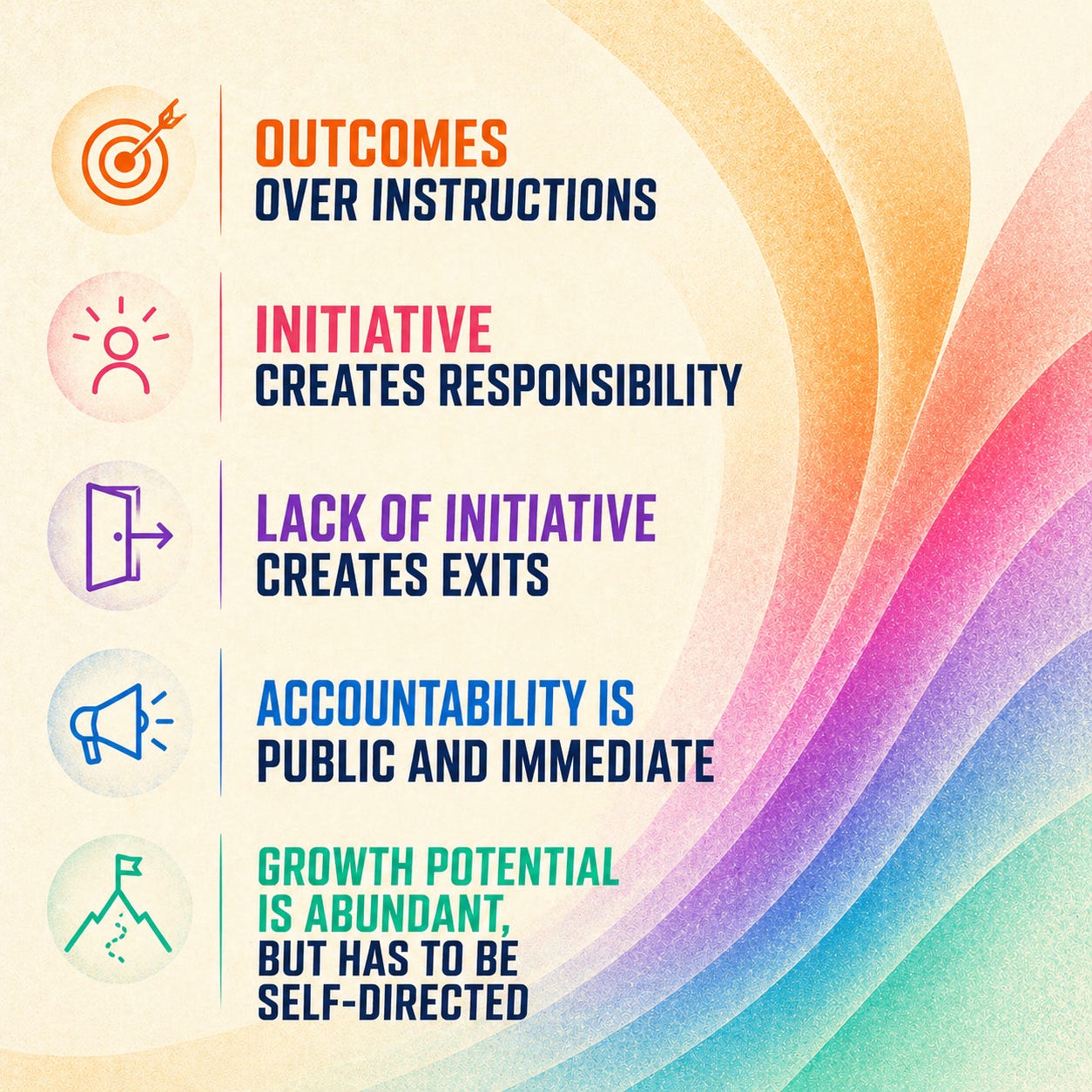
My later boss at Pinterest and now exec coach Cat says this is setting the culture and holding people accountable. There weren’t platitudes stapled to the walls. But we all knew what working at Grubhub was about.
Founders don’t scale management.
They scale expectations, context, and consequences.
Pretty soon I was managing people myself at Grubhub. After firing my first direct report and having my second quit after two weeks, I learned a different system. The traditional management system. Situational leadership. Andy Grove. 1:1’s. Career planning. I built a high-performing team that helped IPO the company.
The founders at Pinterest probably wouldn’t hang out with the Grubhub founders in real life, but they had a remarkably similar approach here. We were expected to grow usage of the product on the growth team at Pinterest. If we didn’t, they’d find people who would. But we needed to figure out how on our own. I remember one time Cat asked our co-founder Evan why he didn’t spend more time with the growth team. He responded, “What the hell do I know about growth?”. That was our job to figure out.
How much latitude we were given to grow the product created the impression the founders didn’t really care about growth. But any doubts about that were settled when I received a handwritten letter in the mail from Evan when we crossed a critical growth milestone talking about how much it meant to him that this many people could now experience the product.
When I joined Eventbrite, I was reporting to a founder again in Julia, and I knew what to expect. When you report to a founder, they’re not expected to manage you. They hired you because you’re supposed to know better than them, and they have likely never done your role before anyway. If you can’t figure it out on your own, they hire someone who will.
Many of the management habits I had leveraged at Grubhub when we were scaling or at Pinterest were counterproductive with Julia. 1:1’s didn’t create clarity. They fragmented it. I had to eventually say we can’t make decisions in 1:1’s anymore. They have to happen at the weekly executive team meeting so everyone stays aligned. Those meetings became our central system. When the pandemic hit, career planning went out the window. We had to help the company to survive. But I still did 1:1’s, skip levels, quarterly planning, all to wrap my head around and manage a large team.
I don’t do most of those rituals anymore. Most management best practices around being a manager don’t apply to founders, both in the early stage and at scale. Why is this?
Founders operate under two constraints:
They’re scanning the entire company all the time, which destroys their bandwidth
They often haven’t done the jobs of the people they manage, so they can’t coach them in detail
Jensen came right out and said it recently. He doesn’t care about span of control with 60+ direct reports. He doesn’t have 1:1’s. He gives critical feedback in public so everyone can learn faster. This violates every management best practice. He’s still right. This looks very different at Nvidia than it does at a startup. The scale is different. The constraint isn’t.
This is not founder mode either. That’s about who makes the call. This is about how founders operate day-to-day when they don’t have time or expertise to manage people the traditional way.
This model has real flaws:
It only works for high agency people (seasoned operators at scale, self-starters at startup)
It under-develops or filters out everyone else
It can become an excuse to abdicate your responsibilities
The result: employees don’t reach their full potential, and you quietly cap who can succeed in your company.
What makes this ironic is the first people you hire join to learn from you. But to scale, they have to learn to manage in ways you don’t.
Founders don’t scale by managing people better. They scale by making the system clearer. That system will be different for every founder. And most of the team still won’t get it. But more of them will. If you want to know whether you’re managing as a founder or just not managing, look at the clarity of your system, not your rituals.
Ask my SuperMe more about this topic.
Currently listening to my Spring #2 playlist.
I understand why corporate mentorship isn't a fit for startups. But why shouldn't startup mentorship work in the corporate environment? 'Cause it sure seems like corporate mentorship is lacking based on the number of people bailing.
Thanks for sharing your experience, it's so interesting! I loved environments where you fall into multiple growth opportunities and flex knowledge learning on the fly but it can also be so stressful. You kind of have to really love it I would say or even just be a bit obsessed with the chaos of innovation.