

Oklahoma and Missouri share a small border smack dab in the middle of America. To most people, they look interchangeable. They aren’t. Oklahoma is known as the Sooners for entering the territory to claim land before the U.S. government made it legal. What began as an insult became a badge of honor. Missouri is called the Show-Me State. Missourians pride themselves on skepticism. You can’t tell them. You have to show ‘em.
Sooners and Missourians
Sooners and Missourians can sit in the same demo call and look identical on paper. Here’s how they actually behave.
Sooners
Want to be early
See themselves as “in the know”
Curious by default
Tolerant of rough edges in your product
Motivated by status and play
Missourians
Skeptical
Risk-averse
Require evidence
Financially grounded
Need proof before committing
Sooners adopt because they want to be early.
Missourians adopt because they want to be right.
You’re Probably Talking to the Wrong Customer
Early founders need Sooners. They try things. They explore edges. They lean into potential. Their engagement is your early signal of progress.
Missourians look valuable to founders. They usually aren’t. They give rational feedback, but don’t spend real time with the product. They point out gaps. You close those gaps. Nothing changes. What needs to be resolved first is scale and proof that others are finding value. Early on, you should largely discard Missourian feedback. That means you need to identify them quickly.
Sooners reward vision. Missourians demand infrastructure.
How To Tell Who You’re Talking To
Both personas, fortunately, reveal themselves quickly.
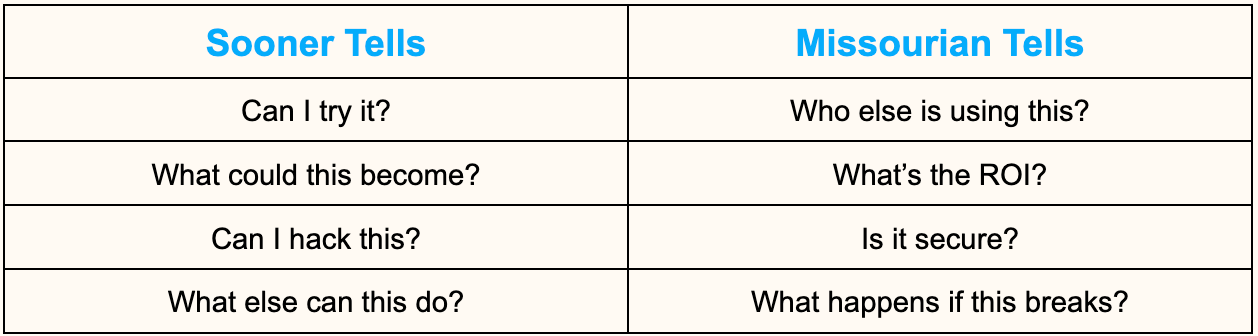
Chasm Crossing vs. Crossing State Lines
In enterprises, this is frequently talked about as the product adoption curve. The difference isn’t timing. It’s motivation. In Reforge, we teach that all user behavior is motivated by either social, financial, or personal utility. In simple terms, a product must help me signal identity, make money, or create personal utility.
Sooners want to accrue social status, be able to explore, and have fun with some potential upside later on. Missourians want money, risk reduction, clear ROI, and proof from their peers beforehand. Crossing the chasm is not just distribution. It’s about rearchitecting the motivations behind using your product.
Migrating from Oklahoma to Missouri
When you move from Sooners to Missourians, the product must change. Social capital must become financial capital. Attention must turn into income. Play must become business. “Show me” often means “show me the money.” This is why most direct network effect businesses evolve into cross-side network effect businesses at scale. Creator vs. consumer. Buyer vs. seller. User vs. advertiser.
“Where are the ads?”
Missourians get confused when they don’t see transaction economics. They want money made visible. It reassures them they aren’t being taken advantage of. For example, when I was early at Grubhub, someone asked us why we don’t show ads. They didn’t realize we took a percentage of every order, which, when converted to an ad-based metric like CPM, was far more lucrative than any ad unit we could run. Ads would have reduced orders and cost us money.Similarly, people have asked me why I don’t monetize my blog. My response has been that I do. It drives leads to and improves conversion rate for my advising business and for full-time job opportunities. I make far more from those activities than I would from the occasional sponsorship.
–
Every product starts in Oklahoma. Every successful one eventually crosses into Missouri. The mistake is trying to build for both at the same time. Know which state you’re in, and listen and build accordingly.
Ask Casey AI about this topic on SuperMe.
Currently listening to Container by Lackluster.